
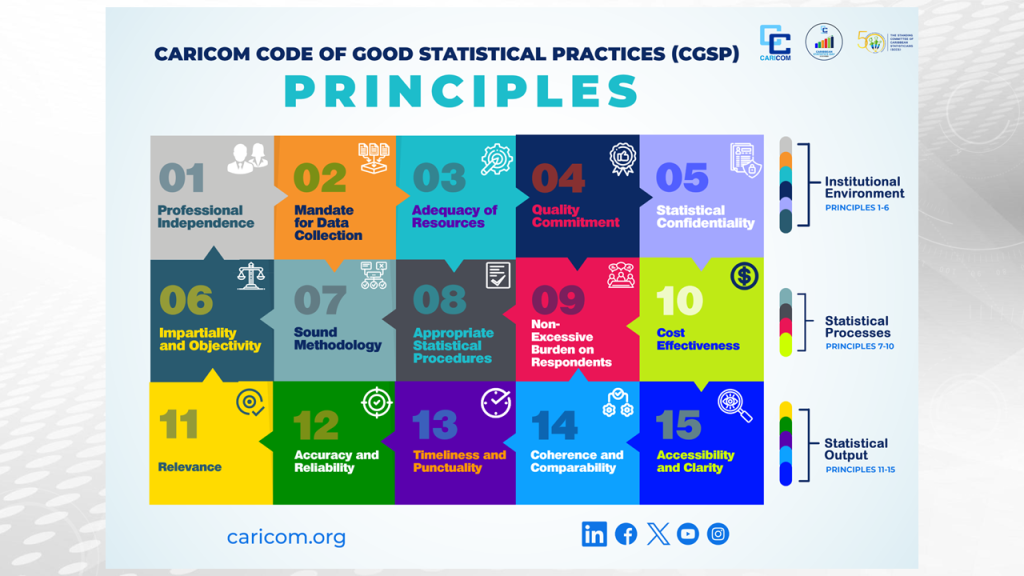

The CARICOM Code of Good Statistical Practices (CGSP) defines 15 principles that govern the institutional environment, statistical processes, and statistical outputs of National Statistical Systems within CARICOM.
These principles are supported by 77 indicators, which provide detailed guidance on best practices and standards for implementing and assessing each principle. Together, the principles and indicators serve as a comprehensive framework for promoting quality, integrity and professional independence in the production of official statistics across the Region.
Background
- At the 6th Meeting of the Advisory Group on Statistics (AGS) in 2010, the need for a Code of Ethics for Statisticians in CARICOM was formally recognised.
- This need was identified by consultants working on the update of the Regional Statistics Work Programme (RSWP), which was funded by the 9th European Development Fund (EDF). The consultants recommended using the European Union’s Statistics Code of Practice as a model for developing a regional Code.
- Under this project, the Code was first applied in Member States and Associate Members in 2010, using a structured assessment questionnaire.
- The CARICOM Code Good Statistical Practices framework was subsequently endorsed as an overarching approach to improving statistical quality across the Region and as a vital mechanism for assessing, including self-assessing, the quality and good practices of official statistics within CARICOM.


Developing the Peer Review System
- Following discussions on the results of the second administration of the CARICOM Code of Good Statistical Practices (CGSP) in 2013/2014, the 15th Meeting of the CARICOM Advisory Group on Statistics (AGS) made the following recommendations:
- The Fifteenth AGS recommended that a peer review be undertaken in countries, as an initial mechanism to audit and validate the results of the CGSP self-assessment.
- In implementing this recommendation, the Member State of Suriname volunteered to develop a paper for consideration by the AGS on the establishment of a Peer Review System for the CARICOM CGSP.
- Subsequently, at the 16th Meeting of the AGS, a paper outlining a draft peer review system for the CARICOM Code of Good Statistical Practices was presented.
Proposed Peer Review System
- At its 42nd Meeting in October 2017, the Standing Committee of Caribbean Statisticians (SCCS) endorsed the recommendations of the Advisory Group on Statistics (AGS) regarding the next steps for implementing the Peer Review process. These actions included:
- Preparation of the Draft Summary and Conclusions of the virtual Peer Reviewer meeting;
- Establishment of a forum to support the continued training of Peer Reviewers;
- Development of a checklist of requirements for both Reviewers and Reviewees;
- Creation of a responsibility matrix to clarify roles and accountabilities; and
- Determination of the timing for conducting the Peer Review, scheduled for July/August 2018.
- The SCCS further noted that the principles of the CARICOM Code of Good Statistical Practices form the foundation of Quality Assurance and are aligned with ongoing work under the CARICOM Quality Assurance Framework.
- Additionally, it was noted that the CGSP self-assessment exercise should be conducted through a collaborative process, involving all staff of the National Statistical Office (NSO).

The Peer Review System
The CARICOM Peer Review Methodology, developed and piloted under the 11th European Development Fund (EDF), is a key mechanism for assessing compliance with the CARICOM Code of Good Statistical Practices (CGSP). Embedded within the CARICOM Quality Assurance Framework (CQAF), the methodology supports continuous improvement of official statistics across the Region.
The Peer Review process:
- Provides structured and independent assessments of national statistical practices;
- Identifies strengths, gaps, and opportunities for improvement; and
- Promotes transparency, accountability, and regional harmonisation of statistical systems.
Peer Reviews are conducted by teams of three to four qualified statistical experts from CARICOM, who assess the level of compliance of National Statistical Offices (NSOs) with the CGSP.