2020 Census Round Preliminary and Final Reports

About the 2020 Census Round

The 2020 Census Round in CARICOM is a coordinated effort by CARICOM Member States and Associate Members to collect population and housing data using internationally recommended standards. Although the intended reference years in the Region were 2020-2022, data collection and publication schedules vary by country, partly due to the COVID-19 pandemic. The census provides essential information on: Population size, structure, and distribution, Housing characteristics, Education, Labour force and Migration trends.

Quick Insights:

Median Age in CARICOM

      • Youngest Population: Belize (25 years)
            • Total population size 397,484

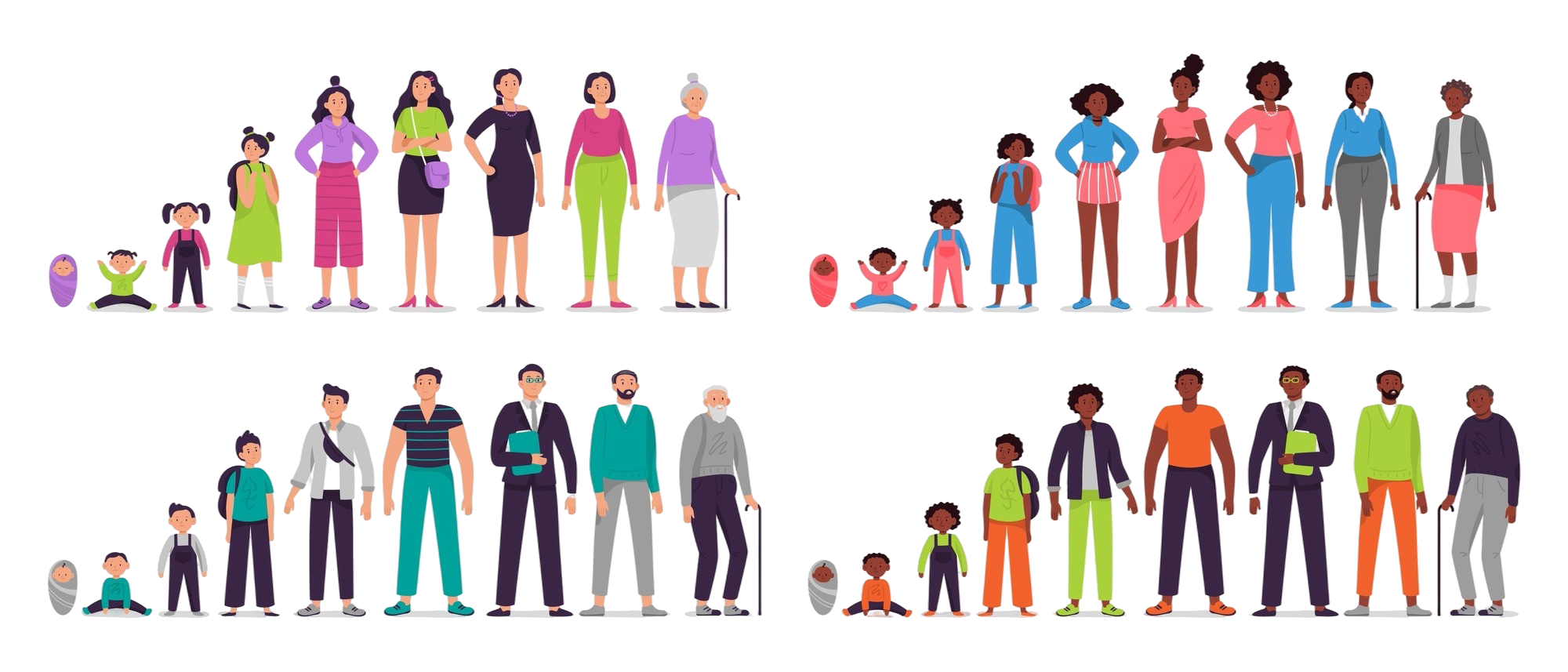
            • The median age of 25 indicates that half of the population is below 26 years, reflecting a predominantly youthful demographic structure.

          • A low median age can also correlate with low life expectancy, reflecting broader health and social challenges.

      • Oldest Population: Curacao (49 years)
            • Total population size 155,826

            • With a median age of 49, half of the population is above this age, signifying an ageing population.

          • The proportion of people aged 65 and older is almost a quarter (24.7%) of the total population.

    • Other CARICOM Populations: Median Ages 33–44 Years
          • This suggests a moderately mature population structure, with a substantial proportion of working-age adults relative to younger and older cohorts.

        • This also suggests, balanced dependency ratios.
COUNTRY CENSUS YEAR TOTAL POPULATION SEX RATIO1 TOTAL DEPENDENCY RATIO2 MEDIAN AGE3 DWELLING UNITS
Bahamas 2021 398,165 92.8 54 33 144,128
Barbados 2021 269,090 93.5 52 42.5 73,571
Belize 2022 397,484 97.0 49.8 25.7 110,718
Bermuda 2016 63,779 92.7 46 44 28,192
Cayman Islands 2021 71,432 102.6 31.5 38 29,699
Curacao 2023 155,826 82.0 45.9 49 60,075
Grenada 2022 109,021 100.1 53.7 34.7 40,990
Guyana 2022 878,674 100.7 218,019
Jamaica 2022 2,774,538 926,815
Montserrat 2023 4,386 99.6 56.3 43.5 2,252
St. Kitts and Nevis 2021 51,320 95.0 40.5 34 21,677
Saint Lucia 2022 171,832 97.2 44.5 36.8 65,951
  1. Sex Ratio Indicator- males per 100 females ↩︎
  2. A low dependency ratio indicates a healthy economy where a sufficient number of working-age individuals can support the dependent population, typically those aged 0-14 and over 65. ↩︎
  3. The median age of a population is the age at which half the population is older and half is younger ↩︎
Dwelling Units per 1,000 People

Dwelling Units per 1,000 Persons

Housing Availability in CARICOM Countries

Recent census data across 12 CARICOM countries shows significant variation in housing availability:

  • High availability: Montserrat, Bermuda and Cayman Islands lead with over 430 dwelling units per 1,000 persons.
  • Moderate availability: Curacao, Saint Lucia, Grenada and Bahamas have between 360–386 units per 1,000 persons.
  • Lower availability: Guyana, Barbados, Belize and Jamaica have fewer than 335 units per 1,000 persons.

Hey! I am first heading line feel free to change me

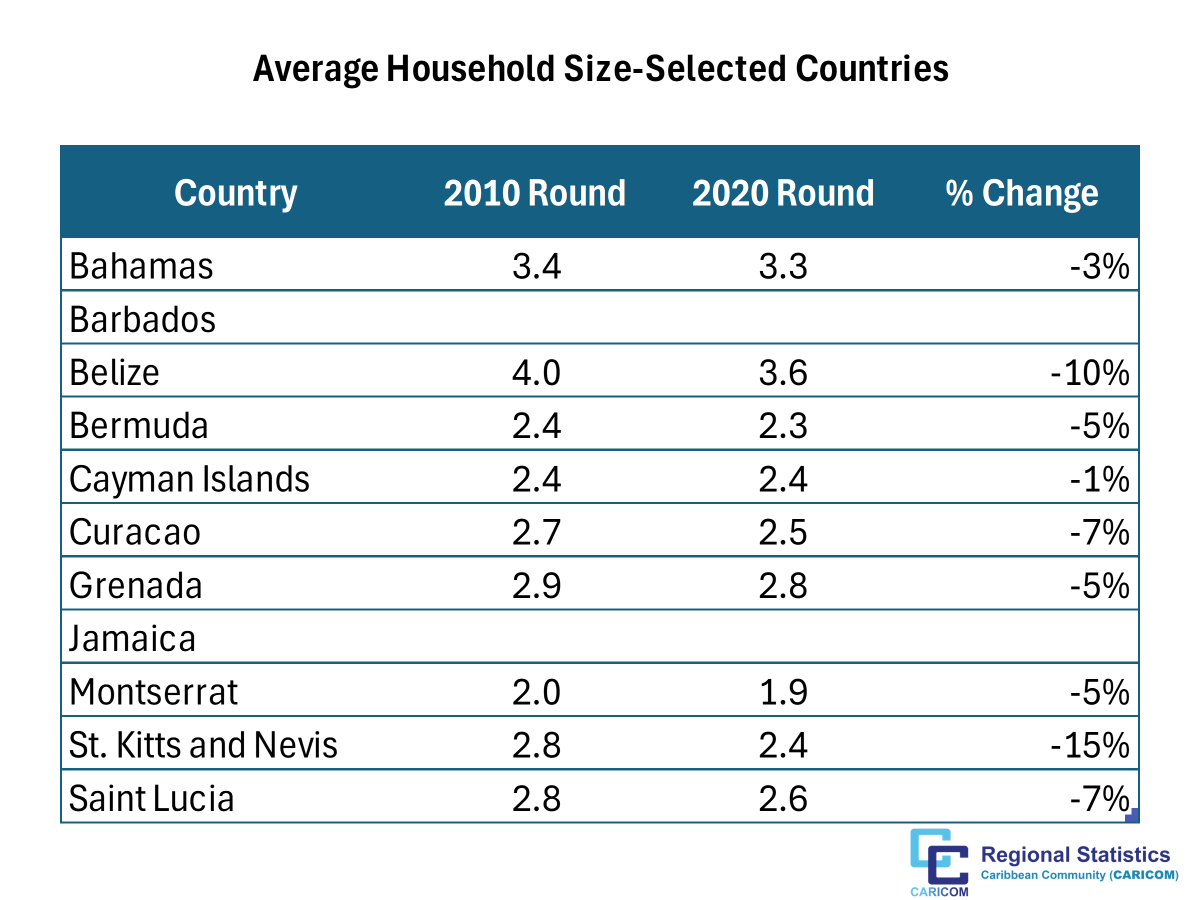
St. Kitts and Nevis experienced the most pronounced decrease (–15%), from 2.8 to 2.4 persons per household, while Bahamas recorded a small decline of –3% and Cayman Islands remained essentially stable, with only a –1% change.

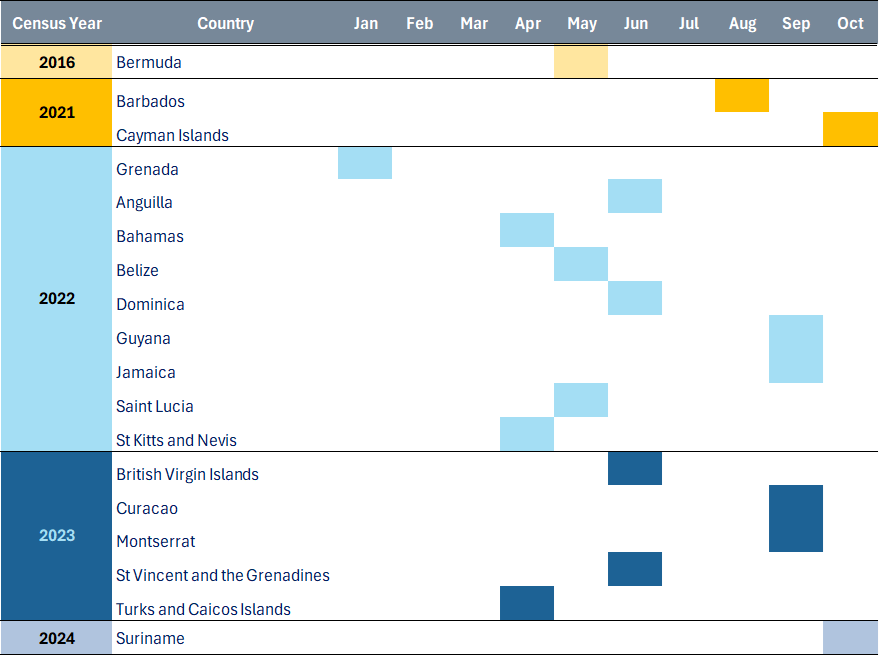
When were censuses conducted during the 2020 Census Round?

Census Reference Years for the 2020 Round

Population and Housing Censuses were not conducted by Antigua and Barbuda and Trinidad and Tobago during the 2020 Census Round, although preparatory activities had been initiated. Haiti was unable to participate in the round due to prevailing civil unrest.

Census data are best used for population counts, small-area analysis, and demographic profiles. Because census years differ across countries, users should exercise caution when making regional comparisons.

Several countries in CARICOM postponed enumeration due to COVID-19, leading to variation in census years and publication timelines. This page is regularly updated to reflect the latest available data.

High-quality census data is fundamental to monitoring more than 30 Sustainable Development Goal (SDG) indicators. It is strongly linked to progress on Goal 1 (No Poverty), Goal 3 (Good Health), Goal 4 (Quality Education), Goal 5 (Gender Equality), Goal 6 (Clean Water), Goal 10 (Reduced Inequalities), and Goal 11 (Sustainable Cities).

Country Census Data: Results and Reports

Bahamas

Census 2021
Males– 191,667
Females– 206,498
+ Total– 398,165
Intercensal change– 13.3 %

Barbados

Census 2021
Males– 130,037
Females– 139,053
+ Total– 269,090
Intercensal change– 3 %

The Estimated Resident Population is derived from 2010 estimates, adjusted by births and deaths each year to 1st August 2021, and net migration

Cayman Islands

Census 2021
Males– 34,823
Females– 33,927
+ Total– 71,432*
Intercensal change– 29.2 %

* During the census of 2021, the gender of 61 individuals is not known. *


71432 is total estimated population

Curacao

Census 2023
Males– 70,162
Females– 85,596
+ Total– 155,826*
Intercensal change– 3 %

* During the census of 2023, the gender of 68 individuals is not known.

Grenada

Census 2022
Males– 54,542
Females– 54,479
+ Total– 109,021
Intercensal change– 2.2 %

Guyana

Census 2022
Males– 440,882
Females– 437,792
+ Total– 878,674
Intercensal change– 17.6 %

Jamaica

Census 2022
Males
Females
+ Total– 2,774,538
Intercensal change– 2.8 %

Montserrat

Census 2023
Males– 2,189
Females– 2,197
+ Total– 4,386
Intercensal change– 11 %

St Kitts and Nevis

Census 2021
Males– 25,000
Females– 26,320
+ Total– 51,320
Intercensal change– 8.7 %

Saint Lucia

Census 2022
Males– 84,714
Females–87,118
+ Total– 171,832
Intercensal change– 3.8 %

Other Resources

Hey! I am first heading line feel free to change me

Reports from Previous Census Rounds 

Hey! I am first heading line feel free to change me

CARICOM Regional Census Strategy for the 2020 Round

Supported by: